
‘For this delight of mine… is not without peril’: Navigating Mining Frontiers in the Kingdom of Hungary (16th-18th Century)
ReForm Scholar
This project explores the extraction, transformation, and dissemination of metal and mineral commodities in the early modern Kingdom of Hungary, focusing on modern-day Slovakia: a region marked by extraction, military-political conflict between the warring Habsburg and Ottoman Empires, and the dynamic movement of knowledge, practices, and people. Working with a diverse source base – from contemporary travel writing, mining regulations, and images and objects created by, and for, mining communities – the project demonstrates how mining activities were understood within early modern cosmologies; cosmologies that did not juxtapose Nature and Culture, and that understood human bodies as shaped by, and shaping, the material world from which they were composed.
Throughout the late fifteenth and early sixteenth centuries, Hungarian mining sites were largely under the aegis of the Fugger-Thurzo Company (Gemeiner Ungarischer Handel), following a contract between the Augsburg merchant family, the Fuggers and the Zips (Spiš) merchant Hans Thurzo and his sons. The Fuggers maintained an extensive network of European-wide distribution centres, through which Hungarian copper was traded and used to both finance and materially enable overseas colonial expansion, sold in Antwerp and loaded onto colonial vessels. The contract between the Thurzo’s and Fugger’s slowly dissolved, and by the mid-sixteenth century, mining operations had been taken over by the Habsburg Crown, administered from Vienna and overseen by dense webs of local mining administrators. Starting from this ‘high-point’ of frontier production, this project explores how sustained extraction across Slovakia’s productive and military frontiers was structured by concerns about the economy, the environment, health, and religion.
The project problematises and extends the concept of the ‘commodity frontier’, developed by Jason Moore and Sven Beckert et al. These authors conceptualise frontiers that are constantly in flux, moving from place to place, landscape to landscape, as the exploitation of resources (land, labour, food, and energy) is exhausted. The commodity frontiers model has been enormously productive for understanding capitalism’s ecological dimensions. But its focus on commodity flows – for example, of sugar, cotton, and silver – can obscure the cultural and spiritual labour that made early modern extraction thinkable and sustainable. This project examines how the concept of the commodity frontier holds, and where it strains, when applied to a site defined not only by material extraction but by the cosmological frameworks through which that extraction was understood, legitimised, and practised.
The primary aim of this project is to explore how early modern mining frontiers were not simply proto-industrial stepping-stones, paving the way for technological advances, but coherent worlds in their own right: sites where the extraction of mineral wealth was embedded within cosmological frameworks that understood the earth as animate, responsive, and morally implicated in human activity. Furthermore, it intends to explore how paying attention to specific local conditions above and below ground – for the case of Slovakia, soil rich in sulphides, with poor groundwater drainage, and constantly threatened with military intervention – can contribute to the development of environmental economic theory. As such, the project aligns with and contributes to the ReForm Campus’ fields of research, exploring the relationship between resources and community: how the knowledge and practices that structured early modern mining contributed to people’s sense of space and place, yet were simultaneously shaped by (and inseparable from) a materialised, embodied understanding of humans in the world.
Ultimately, it hopes to highlight that, in a time of ecological crisis, our way of existing is not the only way of living on Earth; that the logics of twenty-first-century Western Capitalism were not foretold, and that by looking backwards, up, and down (not just forwards) there are ways of imagining our future differently.
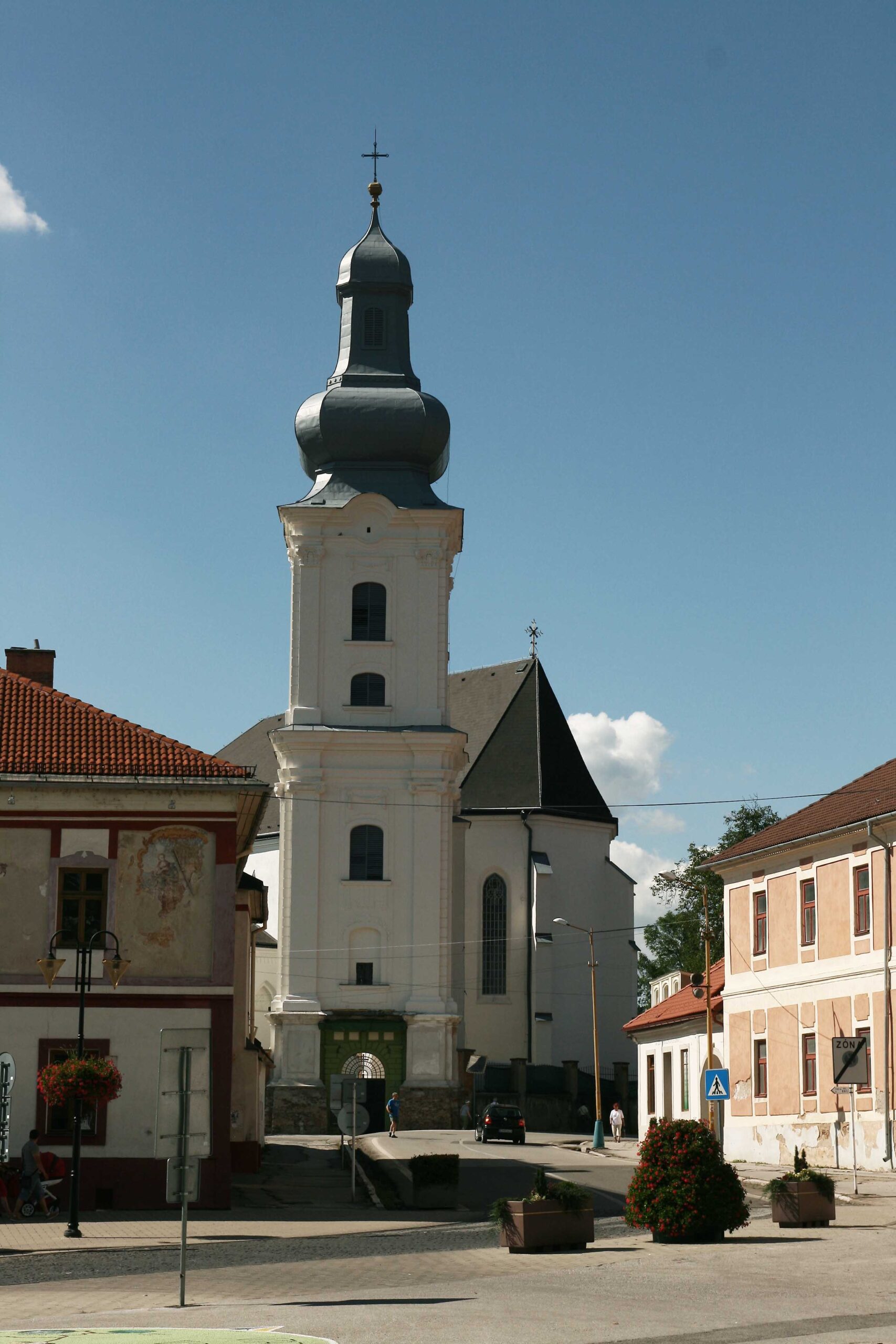
Cathedral of the Assumption of the Blessed Virgin Mary, Rožňava: A gothic church in the mining town of Rosenau (Rožňava), which houses the Rožňavská metercia painting. The painting depicts St Anne, the Virgin and child in the foreground, set amidst a landscape of mining and ore processing.
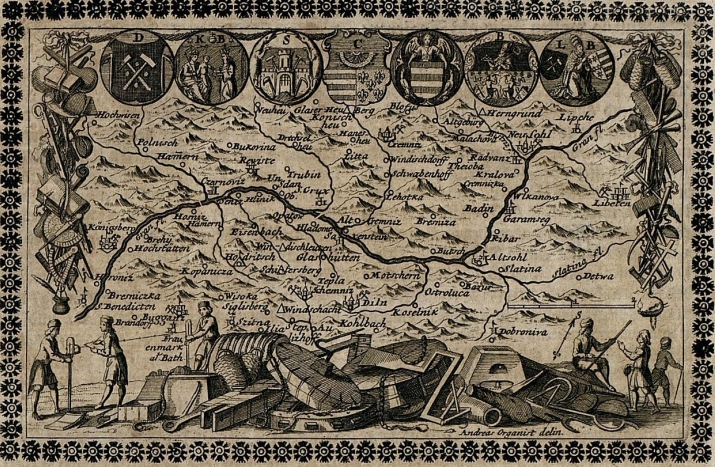
Wolfgang Fürst, Neue Berg-Ordnung Deß Königreichs Ungarn…,1703, p.22: This map is taken from Fürst’s compilation of the mining ordinances that governed the region. The mining towns on which this project focuses, marked by the crossed hammers. The map is framed by all sorted of instruments relating to mining, from alchemical alembics, boundary making instruments, hammers, lamps, quills, and a cross.
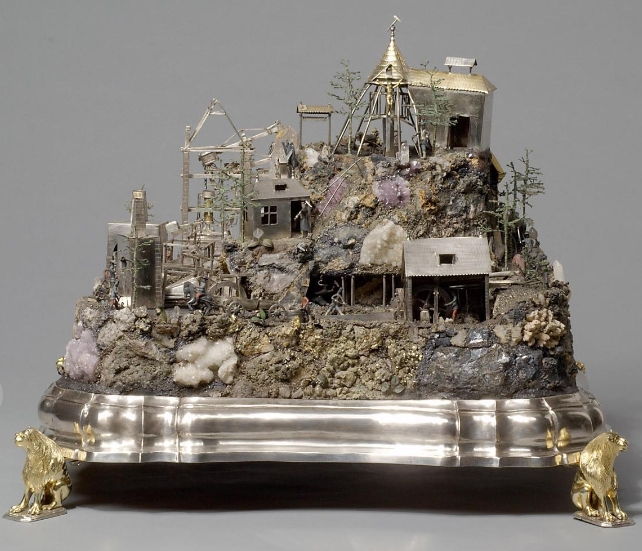
Kunsthistorischesmuseum Wien, Inv. Kunstkammer 4146: The so-called ‚Handstein’ given to Emperor Joseph II in 1764 during his visit to Kremnitz. Made in Slovakia, the Handstein is both made from, and depicts, the gold and silver mines of the region, and includes a model of the ‘atmosphärischen Dampfmaschine’, developed in 1722 to facilitate water drainage. Handsteine were popular objects in the seventeenth and eighteenth centuries, often entered into princely Kunstkammern; a visual and material representation of the abundance of metal and mineral resources in a territory, and the labour relied upon to extract them.